DTF Printing Guide: Process, Benefits & Pricing for Brands
If you run an apparel brand, or you’re about to start one, chances are someone’s already mentioned DTF printing to you. Maybe a supplier brought it up, maybe a competitor switched to it and their shirts suddenly looked sharper. Either way, it’s worth understanding before you commit any money to it.
This guide breaks down the DTF printing process step by step, what it actually costs (real numbers, not vague ranges), where it works well, and where it doesn’t. We’ve pulled this together from what we see day to day at Asiantex, working with brands that are figuring out the same questions you probably are right now.
What is DTF Printing?
DTF stands for direct to film. The design isn’t printed straight onto the shirt. It’s printed onto a film first, then transferred onto the garment using heat and pressure. Simple in concept, a bit more involved in practice.
The core materials are PET film, hot melt adhesive powder, and pigment inks that include white plus the standard CMYK set. That white layer does a lot of the heavy lifting here. It’s what lets a design show up crisp on a black hoodie instead of looking washed out, which older printing methods never handled all that well.
That’s largely why direct to film printing for shirts caught on so fast with small brands and local print shops. You don’t need a massive setup. You can print one shirt today and a thousand next week without much changing.
How DTF Printing Works
Here’s the actual sequence, step by step.
1. Design preparation
Artwork gets set up with the right color profile and resolution. Drop below 300 DPI and the print usually comes out soft or fuzzy once it hits fabric. This step gets skipped more often than it should.
2. Printing on film
The design prints onto DTF transfer film with CMYK and white inks, white going down as a base layer under or behind the color depending on the garment shade.
3. Powder application
While the ink’s still wet, hot melt adhesive powder gets applied across the design. This is the layer that actually glues everything to the fabric later on.
4. Curing
The film runs through a curing stage, usually heat-based, melting the powder into the ink without wrecking the print.
5. Heat pressing
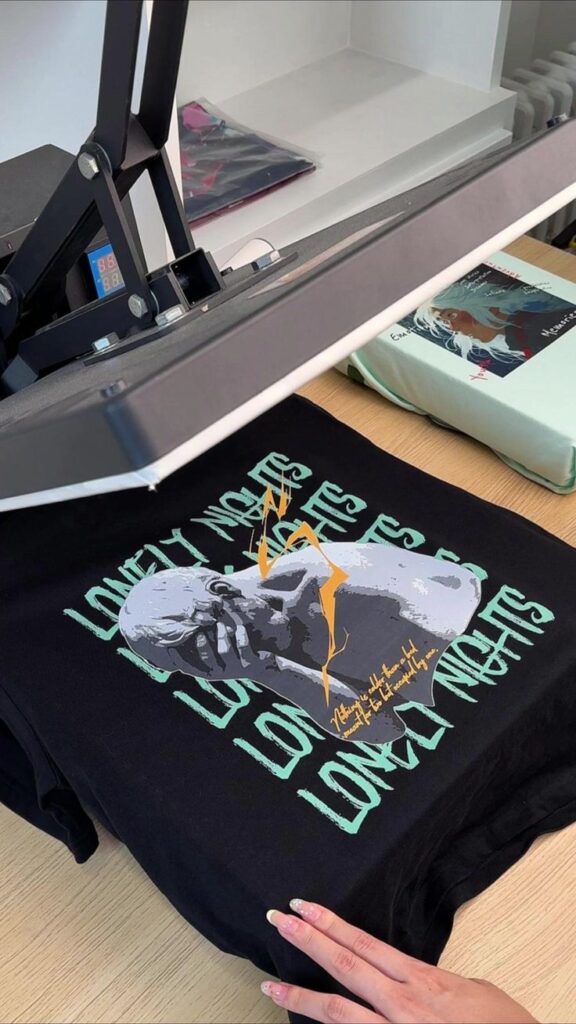
The cured film gets placed on the garment and pressed under heat and pressure for a set time, bonding the design onto the fabric.
6. Peel and finish
The film peels away once cooled (some films peel warm, depending on the type), leaving the transfer behind.
A problem we see fairly often is uneven powder coverage. It leads to patchy spots or prints that start peeling after just a handful of washes. The fix isn’t complicated, but it takes discipline: control humidity in the workspace and recalibrate the powder equipment on a schedule instead of waiting for something to go wrong.
Benefits of DTF Printing
A few reasons DTF has caught on so quickly:
Works across fabric types
DTF printing on cotton comes out sharp and saturated. DTF printing on polyester holds up well too, which isn’t always the case with DTG on synthetic blends.
No real minimum order
One shirt or five hundred, the setup barely changes. That’s a big deal for brands testing a new design before committing to bulk.
Strong color on dark garments
Thanks to the white ink base, designs stay bold on black, navy, or any dark fabric that used to give printers trouble.
Decent durability when done right
Washed cold, turned inside out, DTF prints generally hold their shape and color over normal use. Results do depend on how well the print was cured and pressed in the first place.
How to Identify High-Quality DTF Prints
Not every DTF print is built the same way, so it’s worth knowing what separates a good one from a sloppy one before you place a bulk order.
- Look at the edges. A properly cured print has clean lines, no fraying, no ink bleeding past the design.
- Feel it. A good transfer has a soft, flexible hand feel. If the whole design feels stiff and plasticky, something’s off with the powder or curing.
- Check color evenness. Large blocks of color should look uniform, not patchy or dull in spots.
- Give it a stretch. Pull the fabric gently near the print. A quality transfer flexes along with it instead of cracking right away.
- Ask about wash instructions. A supplier who knows their process can tell you exact wash temperature and drying guidance. If they shrug at the question, that’s worth noting.
DTF Printing vs. Other Printing Methods
DTF isn’t the answer to everything, and it helps to know where it competes and where it doesn’t.
Screen printing still wins for huge orders using one or two solid colors. The cost per unit drops fast at scale. But for small runs or detailed, multi-color designs, screen printing gets expensive quick, mostly because of setup costs.
DTG (direct to garment) prints straight onto fabric and can feel slightly softer to the touch than DTF. The catch is DTG tends to perform best on cotton and can struggle on polyester or blended fabrics, plus it’s generally slower for bulk orders.
So, DTF printing pros and cons come down to this: it flexes across more fabric types and handles small batches without a fuss, but it’s not always the cheapest route for massive single-design runs, where screen printing usually still has the edge on price.
DTF Printing Cost: What Affects Pricing?
These are typical market ranges, not fixed rates, since your actual cost depends on your design and order size. If you want an exact number instead of an estimate, it’s usually quicker to get a free DTF printing quote based on your real files and quantity.
| Factor | How It Affects Cost |
| Design complexity | More colors and fine detail use more ink and film |
| Order volume | Larger orders bring the per-unit price down |
| Garment type | Specialty fabrics may need adjusted heat settings, adding labor time |
| Film and ink quality | Higher grade materials cost more upfront but often last longer |
| DTF printing machine cost | Entry-level units run roughly $2,000 to $5,000; industrial machines can reach $14,000 or more, which affects whether in-house production or outsourcing makes more sense |
Common Applications of DTF Printing
DTF shows up on more than just basic tees:
- T-shirts and hoodies
- Activewear and sports jerseys
- Small batch merch and event shirts
- Tote bags and caps
- Team or company uniforms
Some brands mix decoration methods depending on the product. Custom embroidery services in USA often get paired with DTF for logos on polos or jackets, since embroidery gives a raised, textured finish that certain product lines call for and DTF simply can’t replicate.
Common DTF Printing Mistakes to Avoid
Even shops that have been doing this a while trip over these:
- Under curing. Rushing this step leads to prints that crack or lift much sooner than they should.
- Wrong press temperature or time. Too hot or too long scorches the fabric. Too short and the transfer never bonds properly.
- Low resolution files. Anything under 300 DPI tends to look blurry once it’s pressed onto fabric.
- Ignoring fabric type. Different materials need different heat and pressure settings. Skip this and you risk ruining an otherwise solid print.
- Skipping test prints. A quick test run on new fabric or a large order catches problems before they turn into an expensive batch of mistakes.
Why Apparel Brands Choose Asiantex
As an apparel manufacturer for clothing brands, we’ve worked with brands at every stage, from someone placing their first small test order to established labels running steady monthly production. What comes up most in conversations with clients isn’t speed or price. It’s consistency, meaning shirt number ten should look exactly like shirt number one.
We run quality checks at each stage of production and keep our equipment updated across cotton, polyester, and blended fabrics. We also offer DTF printing services in USA clients count on for both small test batches and larger ongoing orders, so nobody has to choose between quality and flexibility.
Conclusion
Getting familiar with the DTF printing process step by step makes the decision a lot easier, whether you’re placing a small custom order or setting up regular production. DTF isn’t the right fit for every single project. And it won’t replace every other method out there. But for brands juggling different fabric types and order sizes, it holds up.
Still deciding what fits your brand best? It’s worth taking a few minutes to compare DTF to other printing methods before locking anything in. Because the right choice really comes down to your design, your fabric, and how many units you’re printing.
FAQ’s
1. What is DTF printing and how does it work?
Direct to film, that’s what DTF stands for. You print the design on a film first, not the shirt itself. Then adhesive powder goes on, it gets cured under heat, and finally pressed onto the garment. Peel the film off and the design stays put.
2. Is DTF printing better than screen printing?
Depends what you’re doing. For a huge run of shirts in one or two colors, screen printing is still cheaper per unit. But if you’ve got a detailed design or you’re only printing a handful of shirts, DTF makes more sense since there’s no setup cost eating into your budget.
3. How long does DTF printing last?
Somewhere around 50 washes if it was cured properly. Wash it cold, flip the shirt inside out, and you’ll probably get more mileage out of it than that.
4. Can DTF be printed on dark shirts?
Yes, and it actually does this well. There’s a white ink layer underneath the design, so colors don’t wash out on black or navy fabric like they used to with older printing methods.
5. How do I know if a DTF print is good quality?
Check the edges, they should be sharp with no bleeding. Feel the print, it should stay soft, not stiff. Colors should look even, no patchy spots. Stretch the fabric near it, a good print flexes instead of cracking.
6. Is DTF printing good for small businesses?
Yes. No minimum order means you’re not stuck buying 200 shirts just to test one design. Print one, see how it sells, go from there.
7. How much does a DTF transfer cost?
An A3 transfer runs about $0.50 to $0.80 typically, not counting the shirt or labor. Goes up with more colors or a bigger design.
8. What mistakes should you avoid with DTF printing?
Under-curing causes early peeling. Wrong press temperature or timing ruins the bond. Low resolution files come out blurry. And always run a test print before a big order.
9. What products can you print with DTF besides shirts?
Hoodies, activewear, jerseys, uniforms, tote bags, caps. Works well for event merch and small batch runs too.
10. What fabrics work best with DTF printing?
Cotton and polyester both work, and blends too. That’s really the advantage over something like sublimation, which only really works on polyester.