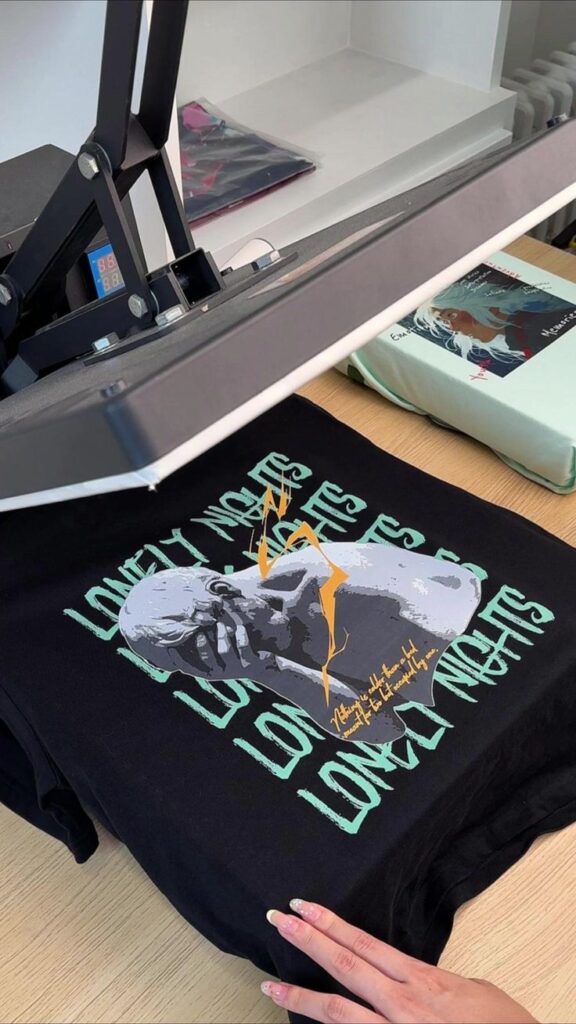
When you’re starting an apparel business or expanding an existing one, picking the right printing method can make or break your bottom line. Three main techniques dominate the industry right now: screen printing, DTG (direct-to-garment), and DTF (direct-to-film). Each works differently, costs differently, and produces different results. But here’s the thing: none of them is objectively “best.” What works for a corporate uniform company won’t work for an artist selling limited drops.
The goal of this guide is to walk you through screen printing vs DTG vs DTF to help you find the best printing method for clothing brands that fits your situation.
Quick Comparison at a Glance
| Method | Setup Cost | Cost Per Shirt | Minimum Order | Turnaround | Best For |
| Screen Printing | $100-$500 | $3-$8 | 50-100 | 5-7 days | Bulk orders |
| DTG | $0 | $8-$15 | 1 | 1-2 days | Complex designs |
| DTF | $50-$150 | $5-$12 | 10-20 | 2-3 days | Fabric flexibility |
What Is Screen Printing?
Ever wonder why screen printed shirts have been everywhere for 40+ years? The method’s simple. You cut a design into a mesh screen for each color. Then you drag ink across the screen with a squeegee and it bleeds through onto the shirt. Five colors in your design means five screens and five passes through the press.
It’s hands-on work, but it produces consistent results every single time. The ink sits on top of the fabric, giving you that solid, permanent feel.
Advantages:
The cost advantage kicks in hard once you hit volume. You pay upfront for screens (roughly $100-$500), but after that each shirt costs just $3-$8. Order 200 shirts and suddenly you’re looking at super low per-unit costs.
The colors don’t fade. Plastisol ink lasts through 50+ washes, sometimes way longer. Customers can beat up the shirt and the design stays sharp. That durability builds brand trust, especially for corporate uniforms or employee gear.
And those colors are bold. You get deep blacks, bright reds, pure whites. None of that washed-out vibe. Brands that want impact go screen printing.
Limitations
Want to print 20 shirts? The setup cost kills the deal. You’re paying hundreds upfront for screens that only print that one design.
Complex designs are a headache. Photorealistic images with hundreds of color gradients become nightmares in screen printing. You’d need a separate screen for each shade variation, which explodes your costs. Stick to simple, bold designs with 2-4 colors and you’re golden.
Best Use Cases
Bulk orders are the sweet spot. Corporate uniforms for a company with 300 employees? Screen printing crushes it. Merchandise businesses printing the same logo every season? Perfect fit. Streetwear brands with signature designs? Also screen printing.
If you need 50+ of the same design, screen printing makes financial sense. Explore our printing services to see if your order qualifies.
Pricing Breakdown
Let’s do the math on a real order. Say you’re printing 100 shirts with a two-color design. The screens cost $500. Printing runs about $4 per shirt, so that’s $400 total. You’re at $900 for the whole batch, which breaks down to roughly $9 per shirt.
But jump to 500 units of the same design. Screens still cost $500. Printing at $3 per shirt comes to $1,500. Your total is $2,000, or just $4 per shirt. That’s the magic of screen printing.
Here’s what real pricing looks like at different volumes:
- 50 shirts: $9-$10 per shirt
- 100 shirts: $6-$8 per shirt
- 300 shirts: $4-$5 per shirt
- 500+ shirts: $3-$4 per shirt
What Is DTG Printing?
DTG feels like magic compared to screen printing. Basically it’s an oversized inkjet printer that sprays ink directly onto the shirt. No screens, no setup drama, no waiting. Print one shirt, then print something completely different next. The machine doesn’t care.
The nozzles are crazy precise. They lay down tiny droplets of ink to create whatever image you want. That’s why DTG handles photorealistic stuff so well.
Advantages
Need to print one shirt? DTG says yes. Need to print one shirt for 50 different designs? Also yes. There’s zero setup cost and zero minimum order. That flexibility opens doors for certain business models.
Artists selling limited-edition merchandise actually make money with DTG. You’re not carrying inventory that never sells. Print when someone orders, ship the next day. Done.
Print-on-demand shops run on DTG. Customer orders a custom design online, DTG prints it, you ship it out. Your risk is zero because you’re not making anything until someone pays for it.
Limitations
DTG is picky about fabrics. It absolutely hates polyester. The ink sits on top of the fibers instead of bonding, and washing destroys it fast. Dark shirts need pre-treatment that adds cost and time. Even then, the results aren’t guaranteed.
The durability trail is rough. Plan on 30-40 washes before the image starts noticeably fading. For screen printing, you get double that. If you’re selling to customers who care about longevity, this becomes a real problem.
Money-wise, DTG gets expensive at volume. You pay $8-$15 per shirt no matter what. When comparing screen printing vs DTG for bulk orders, printing 500 shirts with DTG costs $4,000-$7,500, while screen printing the same order is around $1,500-$2,000. That gap matters when you’re scaling.
Best Use Cases
Artists, musicians, and creators with detailed designs. Brands doing print-on-demand. Anyone who values flexibility and speed over per-unit cost.
If your designs change frequently or you need to respond to trends quickly, DTG gets you to market fast. No waiting for screen setup, no holding inventory on designs that might not sell.
Pricing Breakdown
One shirt with DTG costs $15-$25. The printer has overhead, the ink isn’t cheap, and you’re paying labor for setup and printing. Order 50 shirts and the price drops to $10-$12 each. Order 100 and you’re at $8-$10 each.
Notice the pattern? Even at higher volumes, DTG doesn’t get super cheap. You’re basically paying for convenience and flexibility.
- 1 shirt: $15-$25
- 10 shirts: $12-$15 each
- 50 shirts: $10-$12 each
- 100 shirts: $8-$10 each
What Is DTF Printing?
DTF is the new kid and it’s honestly the most flexible. The printer first sprays your design onto a special film, kind of like temporary tattoo paper. Then a heat press transfers that design from the film onto the garment. The design sticks to the shirt instead of sitting on top of it.
The genius part? It works on every fabric. Cotton, polyester, blends, athletic wear, dark colors, light colors. The heat transfers the ink into the fibers regardless of what you’re printing on.
Advantages
You get the durability of screen printing (50+ washes) without the screen printing limitations. The detail of DTG without the fabric restrictions. It’s like getting the best of both worlds.
You can start small. A batch of 10-20 shirts costs $10-$12 per unit. That’s way less risky than screen printing’s $500 setup. But it also scales reasonably. Get to 200 shirts and you’re at $5-$8 per shirt. Not as cheap as screen printing at that volume, but way better than DTG.
The fabric flexibility is huge. Launching a brand where you don’t know which colors and fabrics customers will want? DTF handles it. One method for everything instead of juggling different techniques.
Limitations
You need the right equipment and technique. Heat press temperature’s gotta hit 320-350 degrees, and pressure settings matter. Get it wrong and the transfer peels or cracks. It’s learnable but adds complexity compared to DTG.
The film gets thrown away after use. Not ideal for the environment. Screen printing uses less material overall.
The technology is newer so fewer shops offer it. Availability is growing though. Most major markets now have DTF options.
Best Use Cases
New brands launching without massive capital. You can test designs with small orders and grow into larger batches when you find what sells. Sportswear companies love DTF because polyester fabric works perfectly. When exploring custom apparel printing methods, brands selling multiple colors and styles benefit from one technique handling everything without juggling multiple approaches.
Custom apparel manufacturing becomes simpler when one technique works for all your needs. No more explaining to customers why you can’t print their design on polyester, or why screen printing minimums are so high.
Pricing Breakdown
Order 20 DTF shirts and you’re paying $10-$12 each. Push to 50 and that drops to $7-$10 per shirt. At 200 units, you’re looking at $5-$8 per shirt. The sweet spot for DTF is usually 50-500 units where it beats both competitors economically.
- 10-20 shirts: $10-$12 each
- 50 shirts: $7-$10 each
- 100 shirts: $6-$9 each
- 200+ shirts: $5-$8 each
Screen Printing vs DTG vs DTF: The Real Differences
- Print quality and colors:
Screen printing delivers bold, solid colors that don’t blend. DTG and DTF handle complex, multicolor designs beautifully. Photorealistic work looks best on DTG with light cotton, but DTF comes close on any fabric and lasts way longer. - How long they last:
Screen and DTF both survive 50+ washes without significant fading. DTG starts looking sad around wash 30-40. If durability matters to your customers, that’s a real difference. - Cost at different volumes:
Under 50 units, DTG wins financially. Between 50-200 units, DTF takes it. Over 300 units, screen printing becomes ridiculously cheap. The math is straightforward once you know your volume. - What fabrics you can use:
Screen printing works on everything, every color. DTG hates polyester and dark shirts. When choosing between screen printing vs DTF, the advantage goes to DTF for fabric flexibility since it works on literally any fabric type. If you’re selling variety in your line, DTF removes friction. - Speed:
DTG is fastest at 1-2 days. DTF takes 2-3 days. Screen printing needs 5-7 days because of setup. Rush orders? DTG and DTF win. - Order minimums:
Screen printing demands 50-100 minimum. DTG has zero minimum. DTF sits in the middle at 10-20. Testing designs is easiest with DTG and DTF.
Which Printing Method Matches Your Brand Stage?
Picking the right method depends on where your brand actually is and where you’re going. A startup has different needs than an established brand. Here’s the breakdown.
| Brand Profile | Best Choice | Why |
| New Clothing Brand (pre-launch) | DTF | Low minimums keep costs down; you can test without huge risk |
| Print-on-Demand Seller | DTG | No inventory needed; zero setup; ship orders same day |
| Corporate Uniform Supplier | Screen Printing | Bulk pricing is unbeatable; durability matters for employees |
| Sportswear/Athleisure Brand | DTF | Polyester works perfectly; scales cost-effectively |
| Merchandise/Streetwear Business | Screen Printing | Iconic designs look bold; reprinting year after year gets cheap |
| Limited Edition/Artist Drops | DTG | Unlimited colors; photorealistic quality; no inventory waste |
AsianTex: Your Next Printing Partner
Here’s what most brands get wrong: they choose a printing method in a vacuum. They look up which is cheapest or fastest and go with that. Then six months later they realize it’s not working for their actual business.
The real decision is picking a partner who can grow with you. You need someone offering multiple methods so you can switch tactics without switching manufacturers. Asiantex works with brands at every stage.
Whether you’re testing five designs or reprinting the same winner every month, we’ve got the equipment and expertise. We also offer embroidery services in USA if you want to add that dimension to your apparel without juggling multiple vendors.
Final Thoughts
Screen printing vs DTG vs DTF, the answer to which printing method is cheapest depends entirely on your specific situation. Don’t let anyone convince you one method beats the others across the board because they’re lying.
Once you know what matters most for your brand, the decision gets easier. When you’re ready to move forward, get a free printing quote with your real designs and numbers. It’ll confirm whether you’re thinking about this right, and you’ll have actual pricing instead of guesses.
FAQs
What’s the main difference between screen printing, DTG, and DTF?
Screen printing pushes ink through mesh screens. DTG sprays ink straight onto the shirt like a printer. DTF prints onto film first then transfers it to the fabric.
Which printing method is cheapest for small orders?
DTG wins because there’s no setup cost. Print one shirt or a hundred, you pay roughly the same per piece.
Which printing method is best for bulk orders?
Screen printing becomes unbeatable once you hit 300+ shirts because the setup cost gets spread across so many pieces.
Which method lasts the longest?
Screen printing and DTF both last 50+ washes. DTG fades around 30-40 washes, so it’s the weakest of the three.
Can all three methods print on dark fabrics?
Screen printing handles dark fabrics perfectly. DTG really struggles with them. DTF works on dark fabrics just fine.
Which method is best for detailed, multi-color designs?
DTG is your best bet. It handles photorealistic images and unlimited colors without extra cost or complexity.
Does fabric type affect which method to choose?
Absolutely. DTG hates polyester, screen printing works on everything, and DTF handles any fabric equally well. If you’re selling multiple fabric types, DTF makes your life easier.
Which printing method should a new clothing brand choose?
DTF is the safest bet because you can start with small orders at reasonable cost, test what customers want, then scale up without switching methods.